Friday Rock Blogging: Granite
PZ Myers was right to call for a more inclusive vision of Friday Cat Blogging, noting that 99% of the species on the planet are non-chordates while the Friday Ark continues to be dominated by a small number of mammalian genera. Sadly, his progressive vision of a non-phylist Friday is still stuck within the dominant lifeist framework. Chris Clarke's Friday Fossil Blogging is a step in the right direction, however, True Justice demands Friday Rock Blogging! And we are not ones to resist the call of True Justice.
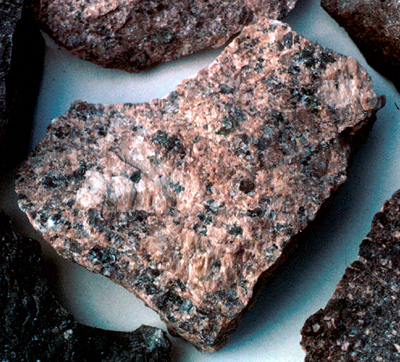
Courtesy the USGS photo library (which is, incidentally, in the public doman, so hoorah!) comes this picture of a chunk of granite from the Precambrian St. Francis Mountains, Missouri. Note the adorable potassium feldspar matrix! Awww.
Gravity Comes from Pine Cones on Mount St. Helens
Without a radio for my morning drive, I can feel ignorance wrapping itself around my shoulders. It's very comforting.
However, not to be missed is that Mount St. Helens is at it again. Check the Volcano Cam, kids, and here are several pretty pictures from last night.
Additionally, there's a new Internet Crackpot of the Week, please get your shards of pottery rattling for Dan Winter and Sacred Geometry!
Be sure to catch the Do You Have a Soul? Test - scroll down just below the scan from a German tabloid. I have two-elevenths of a soul.
However, not to be missed is that Mount St. Helens is at it again. Check the Volcano Cam, kids, and here are several pretty pictures from last night.
Additionally, there's a new Internet Crackpot of the Week, please get your shards of pottery rattling for Dan Winter and Sacred Geometry!
Only this wave music which makes self-similarity - (Golden Ratio) - allows compression to turn in to acceleration (Gravity). This explains the voltage called LIFE from gravity which fresh eggs, pine cones, and your HEART make. It also descibes for the first time WHY objects fall to the ground (charge has a way out thru light speed)- explaining for example why capacitors in a pine cone make gravity (eliminating for example the embarassing need to drive around in cars powered by dinosaurs farting).
Be sure to catch the Do You Have a Soul? Test - scroll down just below the scan from a German tabloid. I have two-elevenths of a soul.
Bad Carma
O Diesel! O Lords of the Highway! O Fickle Imps, who dwelleth in my dash!
What have I done? How can I appease your wrath?
The car worked fine when I bought it. Yesterday, sometime between morning and quittin' time, the turn signal relay died. So here I am this morning, driving along at 65 mph, window rolled down and making absurd uninterpretable arm signals to the traffic, when kerSMACK!!, my back window explodes. Actually it wasn't so much an explosion as a sudden transformation from seamless glass to a mosaic, but it was pretty darn loud and terrifying.
I figured it was a bit of kicked-up highway debris, but no. Nothing hit my car; the window just exploded of its own accord, or more likely the rear defroster's accord. Which shows you what I get for thinking I have a nice touch of luxury in my jalopy! Now I'll need to knock out the pretty translucent mosaic and install some plastic wrap.
On the other hand, my turn signals are working again, hurrah!
I’m Getting Sleepy
Science says: I can't be expected to work in the afternoon, so there.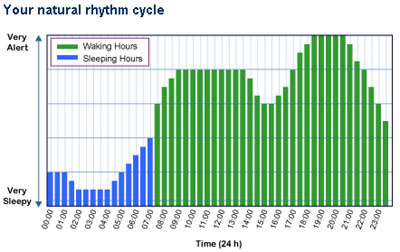
Diesel and Boobies
One: I have a new car, and it's a Mercedes, woo woo! Which would mean I'm moving up in the world, except it's from 2020, has a salvage title, and is ugly as sin. However, it does run on diesel, which means it could theoretically run on vegetable oil at some time in the future - if I decide I want a car after all.
Two: I'm souping up a theme or two for competition. If any of you WordPress 1.5 kidz could play with this one a little, and let me know if you find any bugs, I'd be much obliged. Hit the screenshot to download: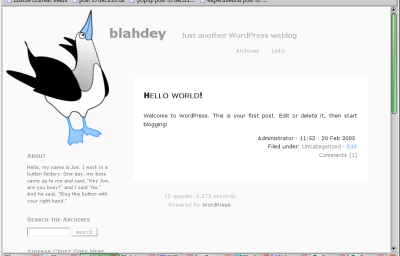
Science Friday on Saturday
Last night's Talk of the Nation topic was delightfully-surprisingly apropos: Oceans! (My trip to Seattle was for visiting the oceanographers and marine geologists, not the earth science department as you might have supposed.) For those of you too lazy to listen to the program, here's a summary:
Ira Flatow: So the U.S. Commission on Ocean Policy released a fabulous report, and the Bush Administration said nice things about it.
Admiral Richard West: Why yes, it was fabulous, and the administrative response appeared unusually reality-based.
IF: So how's the funding situation, then?
RW: Worst. Budget. EVAR.
IF: Let me list some of the oceanographic research-funding agencies that have experienced budget cuts lately.
RW: Here are some more.
IF: What about these other initiatives, have they been funded?
RW: No. By the way, our research fleet is going to explode in three to five years. Not only will the ships not be replaced, the explosions will kill any graduate students on board.
Me: OH TEH NOES!!!1!
Musical Interlude
IF: My next guest is Dr. Deborah Kelley, Associate Professor of Oceanography at the University of Washington.
Me: Squeeee! [So I left the visit feeling like regardless of my nominal advisor, I could easily end up as the transgenic (transmemic?) intellectual love child of almost the whole marine geology department. Which would definitely include Dr. Kelley.]
IF: OMG these new hydrothermal vents are teh sexay!!1!
DK: Doooooood!
IF: No seriously, how sexy is this?
DK: pH 11, yo. Think about it.
Musical Interlude
IF: Blah blah biology.
Dr. Douglas Bartlett: Blah blah blah biochemistry. Blah blah blah.
Ugh Zog
I'm back at work, oh joy of joys! My car is dead, hoorah!
The "nice" text formatting in WordPress - the way it works by default in v1.5, with no formatting plugins enabled, turning line breaks into paragraphs and straight quotes into curly quotes and most importantly, double-hyphens into n-dashes - is the shittiest thing EVAR. It ruins any post that needs an HTML comment inside it. And the unpredictability of it just suxxors. How do I find out what characters it's substituting, and how do I make it stop? (potentially relevant support threads: 1 2 3 - looks like I might have to write a plugin)
Today's Cubicle Survival Game is brought to you by N-Nitrosodimethylamine (NDMA): picture all your coworkers dressed up as candy ravers. Fun for five whole minutes, I tell ya.
Three Parts
Part the First: Look at how I'm defined by the Infinite Teen Slang Generator!
yami
n. a female, particularly a nice one.
"Reggie, that yami is nice!"
Awwww.
Part the Second: How many times have I mentioned that I lived in a dorm with a coed naked hot tub? Clearly not enough to garner a significant audience, as is the way of the world - but surely once or twice. And the discussion of men and nipples in church made me think back on what made me comfortable, or not, as a potential ogle-ee.
It seems to me that there are four types:
- Men who don't see women as full-fledged human beings.
- Men who do manage to see women as human beings, but not as sexual beings, or have a classic virgin/whore dichotomy problem.
- Men who see women as both human and sexual beings, but not at the same time. They're well-behaved, but sometimes shift from normal eye contact to a desperate staring contest. You can see the "oh shit I wasn't supposed to notice or feel anything now I'm stuck" whirling 'round - an admirable sentiment, perhaps, but still an awkward moment.
- Men who are fun to be around in a coed naked hot tub.
Obviously you can cook the categories to apply to women, or same-sex ogling, or whatever other genders and sexualities you've been streaking campus with lately. The point is, I saw an awful lot of young men successfully move from category 3 to category 4; while I can't speak to their inner experiences, from the outside it just doesn't seem that difficult. Contrariwise, there was one notable instance of someone moving from utter misogyny, to at least a theoretical acceptance of women as both human and sexual (in practice it didn't always work out so well) - and clearly freaking the fuck out every step of the way.
Learning to accept the inevitable moments of sexual tension and let them pass, without getting all in a lather - it strikes me as the same thing that happens in meditation, letting your thoughts go and returning to your breath, again and again. Practice, isn't it?
Part the Third: I'm going to Seattle tonight. At this point I can safely say that I'll be leaving LA this summer/fall, driving north along the Pacific Coast until I hit grad school. How far north, exactly, I dunno - thus the going to Seattle - but if you're so inclined, now would be a good time to cast some pearls of grad-school-choosing wisdom.
Part the Fourth, while we're discussing my geography: I'm also planning a trip to Europe in July. The itinerary is Iceland - Norway with family, then Norway - Denmark - ??? - London? doing the backpacking thing with my sister. Any readers out there willing to show two delightful young tourists a good time?
More WordPress Babbling
One: I've gotten my first comment spam on the new system - that was fast!
Two: I have a CSS question for all y'alls. This page was originally set up with a default link-color rule for the sidebar, header, and footer; links in this box, the #content div, were given a special rule: #content a:link { color: #3fa111; }. Fabulous, yeah? But when I wanted to assign yet another set of colors to the links in the entry-titles, using a.googleju:link { color: black } - no dice. The first rule is considered more specific, because it contains an ID selector, and the second rule only has a class selector. Without declaring my googleju rule to be !important, it was dead in the water.
I don't like to use !important - it's poor form. So I rewrote the stylesheet to make the #content colors the default, and declared exceptions for the other three div's on the page. Which is fine, and will work until/unless I decide I need to put two kinds of links on the sidebar. At that point, it seems my only option is to rewrite all my HTML templates (based on the default WordPress theme) to use class selectors, rather than IDs.
So here's my question: is there some sort of reason the default templates are set up with ID selectors?